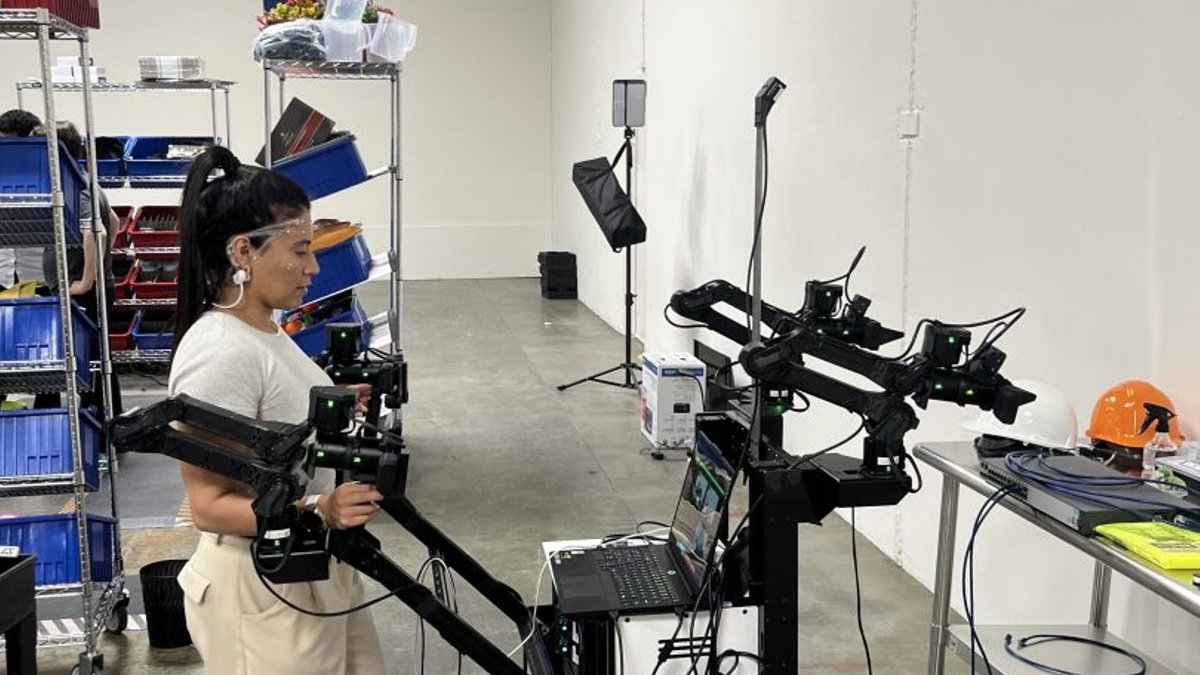
Encord, a data‑tooling company based in San Leandro, California, is testing whether brain‑wave signals can improve the training of robotic manipulators.
Robotic pilots and brain‑wave headsets
In a warehouse filled with wooden blocks, pilot Andrew Ceja removes pieces from a wobbling Jenga tower while wearing a headset that records his visual field and brain activity. The headset, built by German startup Zander Labs, captures electroencephalogram (EEG) data that may indicate error, intent or surprise as the human operator performs the task.
Zander’s neuroscientists, including Lucas Gehrke, argue that moments of heightened brain activity can signal when a robot’s model should allocate more computational effort. Encord’s trial aims to create a brain‑wave‑tagged dataset, run it through client robotics models, and assess any performance gains before deciding on broader adoption.
Why physical data matters for robot learning
Robotics firms increasingly find that existing model architectures are not the bottleneck; the shortage of real‑world training data is. Encord was founded to help companies annotate video for machine‑vision tasks, but as customers move toward end‑to‑end learning for manipulation, they must generate their own data.
Related: Kalshi asks Netflix to remove Prediction Games trailer
“The data simply does not exist,” says Vineeth Velmurugan, Encord’s head of robot learning and former OpenAI robot lab researcher. He notes that scaling physical data collection is far costlier than scraping text for large language models. A dataset five times the size of YouTube’s video corpus may be needed to achieve top performance, highlighting why data generation has become a commercial venture.
Current approaches rely on egocentric video—cameras worn by workers—and remote‑operated robot recordings. Encord supplements these with experiments in its San Leandro facility, testing new modalities such as EEG.
During a visit, pilots used leader‑follower rigs to record tasks like pouring coffee into mugs and stacking poker chips.
Despite the higher cost, the trade‑off is justified because generating physical data cannot be outsourced cheaply like text data. This economic reality differentiates the development of physical AI from the rapid scaling seen in natural language processing.
Related: SpaceX launches V3 Starlink but booster fails again
From a broader perspective, the effort reflects a shift in robotics: as models become more capable, the limiting factor moves from algorithmic innovation to the availability of high‑quality, task‑specific data. Companies that can efficiently produce such data may gain a decisive edge.
Velmurugan’s position between multiple robotics firms gives Encord a view of emerging data‑generation techniques across the industry. He says the company can spot trends before any single customer adopts them, keeping the small team of pilots continuously occupied.
Training robots is never dull.



Leave a Reply