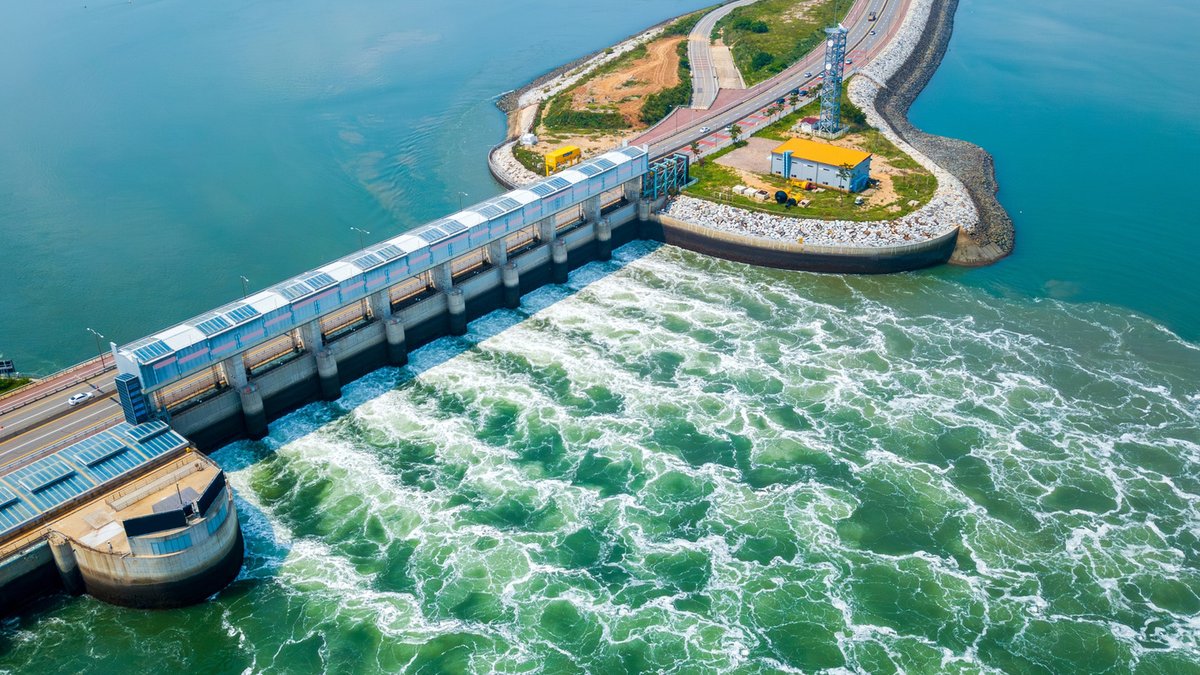
When looking for reliable renewable energy sources, the focus usually lands on solar panels and offshore wind farms. While these options have made impressive strides, a third option receives significantly less attention: tidal energy. This technology uses massive, spinning turbines submerged in the ocean to capture power from the Earth’s natural water movements. It functions similarly to wind turbines, generating electricity with little to no carbon pollution. Despite this potential, organizations rarely build more underwater turbines. The technology has distinct benefits, but it also carries significant drawbacks regarding cost and environmental impact.
Constructing a tidal energy facility presents unique engineering challenges that wind or solar projects do not face. A company must invest heavily in parts capable of withstanding intense water pressure and corrosive seawater. Installation requires specialized machinery that is difficult to deploy and maintain. The logistical hurdles are substantial. In comparison, operating a standard wind turbine runs about $20 per megawatt hour.
Related: Protecting iPhone Batteries for Long Term Use
This financial disparity creates a significant barrier to entry for developers. While the upfront investment is high, the payoff comes slowly. Projects can take several years to complete, and finding a viable site is a complex process. Tidal energy plants require a very specific location, placed at a midpoint between shallow waters and deep depths. They must be deep enough to avoid wave turbulence, yet not so deep that tidal currents lack velocity. Without these natural advantages, the cost of development increases further.
Environmental and operational trade-offs
While the environmental footprint of tidal energy is smaller than that of fossil fuels, it is not entirely negligible. The installation process itself can displace undersea creatures and disrupt local ecosystems. Furthermore, the spinning blades of the turbines pose a physical danger to marine life swimming nearby. Research has also uncovered more subtle impacts. A 2015 study by the European Commission found that the electromagnetic fields generated by turbines can disrupt the magnetic pathfinding abilities of sharks and whales. Additionally, the noise pollution from underwater operations can harm sensitive mammals like seals.
Related: OpenAI launches real-time AI voice platform for businesses
Despite these environmental concerns, the resource itself is effectively inexhaustible. The tides are driven by the gravitational pull of the Sun and Moon, meaning barring a catastrophic event, the resource will never run out. Energy production remains consistent regardless of weather patterns or time of day. This predictability is a major advantage over wind or solar power. However, there is a catch. Tidal energy is intermittent. This limitation means tidal energy cannot serve as a sole power source and requires a backup system or battery storage to function effectively.
While the theoretical power output is high, the practical application remains limited by geography and expense. The reliance on specific coastal locations restricts where these facilities can be built. Developers must balance the need for a dense, consistent energy source against the high costs of construction and maintenance. The technology offers a glimpse into the future of marine power, but it faces a steep climb to compete with established renewable infrastructure. The difference in density between water and air allows for high power output, but it does not solve the fundamental economic hurdles facing the industry. The largest tidal energy generation facility in the world, located in South Korea’s Sihwa Lake, can generate a maximum of 254 megawatts of power. That’s 254 million watts. It typically





Leave a Reply